































On paper, jugger plays like many other sports: score points by getting a ball or ball-like object into the opposing team’s zone. The catch? Getting the ball means trial by foam combat.
“Jugger is a little bit like rugby, but with medieval weapons,” says Zach Smyrl, a practice lead and coordinator for the Colorado State University jugger club. “In the middle of the field, there is a skull. And it’s each team’s job to grab the skull and get it to the opposing team’s pot to score points – and beat the crap out of each other while doing it.”
Jugger is a five-on-five player sport and has two distinct roles within each team. The first is the “qwik,” who is a single unarmed player and the only one allowed to touch the ball – a foam skull – with their hands.
With one qwik on each team, the rest of the players are “enforcers,” who have padded weapons (called pompfens, or spars) and must defend their qwik while making sure the opposing team doesn’t score. By tagging opposing players with the weapons, those players are downed for several seconds.
“It starts out with a mad sprint for the center,” Club President Tayne Lux says. Once the two teams meet, it’s a chaotic struggle to tag as many players as possible, and to get possession of the skull.
“You’re looking for easy wins, ways that your team can advance, players you can down easily … how that interaction goes usually decides how the rest of the game goes, or at least has a strong, strong influence,” Lux says.

A history rooted in Hollywood
Jugger originally comes from the 1989 movie “The Salute of the Jugger,” also known as “The Blood of Heroes” in the U.S. The film takes place in a post-apocalyptic world following a team of “juggs” as they play a brutal combat sport against other teams in different settlements. The fictional game depicted was created by screenwriter David Webb Peoples, who wrote and directed the film, as well as the stunt coordinator, Guy Norris.
Real-life versions inspired by the film then began being played independently in Australia and Germany during the 1990s, and the sport is now played internationally, coming to Colorado for the first time competitively in 2013.
While jugger may often be confused with live action role play, or LARP, this is technically inaccurate. While jugger resembles LARP games such as Amtgard and often has overlap between such communities, jugger has no story elements, and is more strictly a competition. However, many jugger players do go by stage names while playing the sport in a way similar to roller derby.
The jugger club at CSU was founded officially in 2025 with fewer than 10 players. In the time since it has grown substantially with new members, including Milla Betley, who joined this semester.
“I had to cross the field to get to my dorm,” Betley says. “I got stuck by the jugger … and I stood there for too long and Tayne said I should play. and so I did. And then I played every single day of that first week.”
For new players interested in jugger, Betley recommends simply asking questions and listening.
“As a beginner, you pick up a stick that you like – maybe talk to someone about how to use it before you play, and just listen to the more experienced players around you,” Betly says. “They’ll always be able to help.”
For Betley, the weapon of choice was the “slash,” a pole-arm/sword hybrid. Each weapon in jugger has its own sport-specific name. In addition to the slash there’s the “Q-tip,” which is a double sided quarter staff; the “backcharge” a long sword; the “short” and “board,” – a short sword and shield respectively and finally – perhaps the most memorable weapon – the “chain,” a ball on the end of a 3-meter-long rope.
Unlike the other weapons, there can only be one chain player on a team; as per the rules, getting tagged by a chain puts a player down for longer. This in addition to its range and speed means a skilled chain player can be a menace on the battlefield.
At a jugger event on Oct. 25, CTV anchor Brayden Onick took a swing at playing jugger as part of a collaboration with College Avenue Magazine. “Anytime I was facing the chain, I was meeting God,” Onick said after filming.
To view the full jugger segment and show, visit CTV Channel 11
While chains are powerful, they certainly aren’t invincible.
“I gotta say, for me at least, breaking a chain is really, really satisfying because it’s tricky to do,” Betley says. If the ball on the chain wraps around a weapon fully, it is considered disabled (called a chain break).
“You get it at the right angle, and the chain wraps or bounces, and you stab the chain, and you just feel great,” Betley says. “But I happen to enjoy chain breaking, … some people really like winning. Some people really like running. Some people just like pulling off fancy plays. It depends on the person.”
Forging a Foam Fighting Club
The story of jugger at CSU started before co-founder Elijah Rettenmaier got to college.
“Jugger was a PE class offered at my high school,” Rettenmaier says. “I got really into it. So then during summer, going into my sophomore year of high school, I decided to found a club … which has pretty much followed me from my high school to CSU.”
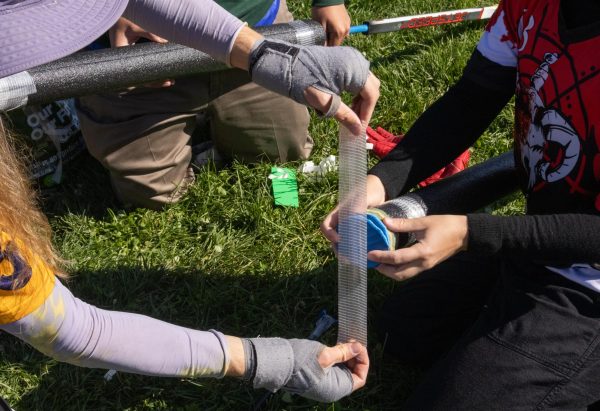
In the beginning the CSU club had few consistent players, but the real challenge, Rettenmaier explained, wasn’t recruitment. It was equipment, as pompfens must nearly always be made by hand.
“You can’t just go to a Dick’s Sporting Goods,” Rettenmaier says. “You gotta buy bamboo. You gotta buy pipe insulation foam, and you got to sit down and really put in the time and energy and money to make this equipment.”
Once a good set of pompfen were made, the next hurdle was registering the club as a student organization. Club co-founder Gabriel Castro, who handled much of the paperwork side of things, says this was easier said than done.
“We are playing a contact sport, so physicality will happen … going through those hoops of insurance and minor liability and other liability was probably our biggest struggle,” Castro says. “That and being able to acquire funding from the school.”
Castro has since left CSU, but still sometimes volunteers with the club, and is a member of the Colorado Jugger League, a nonprofit organization that runs official jugger events – particularly for safety.
Within the jugger rulebook there are regulations and penalties designed to keep players as safe as possible. Still, should something go wrong, Castro says that during all official CJL events, there are on-site medics ready to step in, and that all referees and players are taught the proper procedures for such an occurrence.
Additionally, the construction of pompfen is also regulated by the CJL, not just to ensure fairness, but to ensure safety.
“Every stick or ball or whatever that you see us swinging has not only been inspected based on a rule book, but has been tested to make sure that – should they hit really hard and break – nothing will happen,” Castro says.
The importance of safety isn’t just part of the rules. It’s also part of the culture.
“This is a very honest sport … you call your own hits,” Castro says. “Somebody would be like, ‘Oh, did I hit you? Maybe, I’ll just take it.’ Those kinds of things are important to not only maintain the sportsmanship of it, but it maintains the safety as well.”
Community as well as combat
Part of what makes Castro passionate about jugger is its nicheness, which he says helps create a low-stakes environment for the game.
“Even after the competitive league finals, where emotions ran high and spirits were broken, we all then went and got beer together,” Castro says. “That’s something you don’t see after a football game.”
As club president, Lux also enjoys the environment. “It’s a really accepting, really friendly community … you can go up to anybody and be like, ‘Hey, can I spar you?’” Lux says. “There’s a big culture of teaching people and bringing people in.”
For Rettenmaier, one of the highlights of jugger is its diversity, particularly as a co-ed sport.
“We have a lot of LGBTQ community; we have a big nerd community; we have a lot of people who are like dead set on sports,” Rettenmaier says. “And I think that’s what I love so much about it … it’s a big community of a whole bunch of different people.”