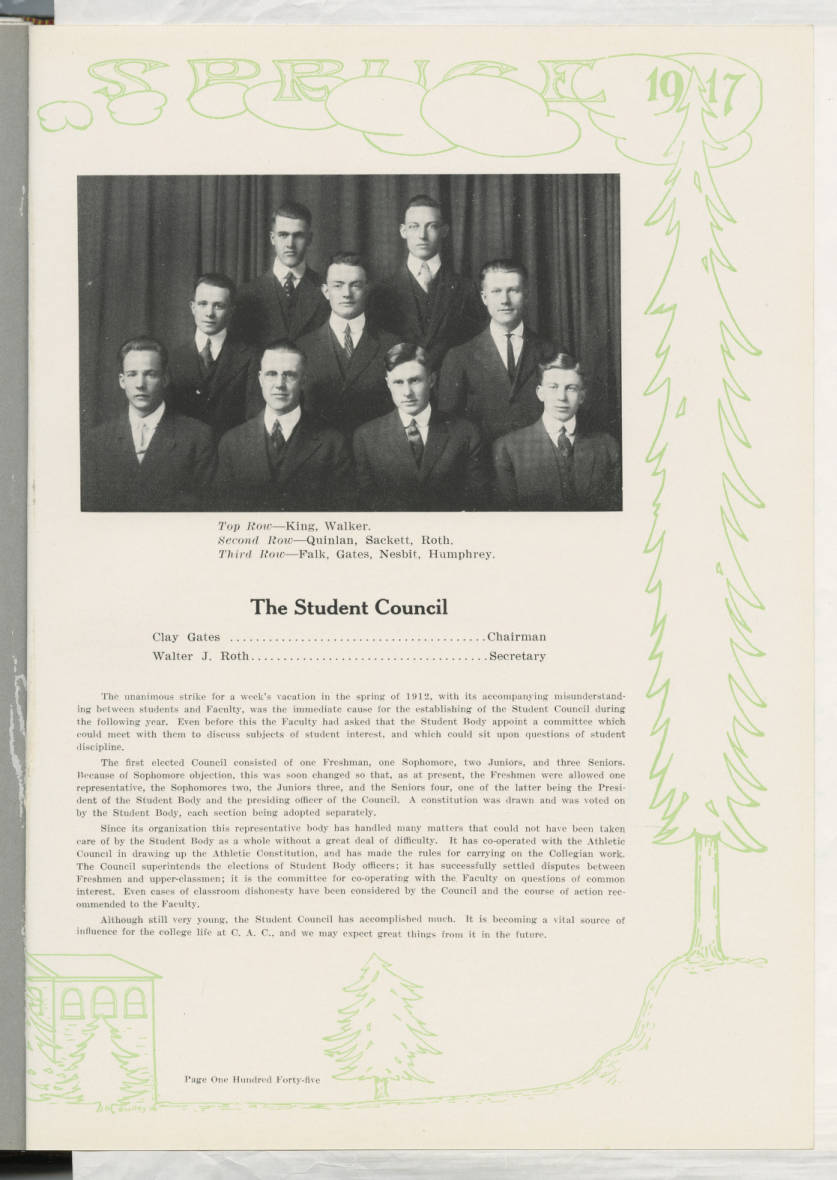
By 1916, most student organizations at what was then Colorado Agricultural College were largely disorganized, had little oversight and had almost no structure for funding themselves, according to Colorado State University history expert James Hansen and his book “Democracy’s college in the centennial state: a history of Colorado State University.”
There was a need for an organization that could encompass and manage funding for all student fees and organizations, leading to the creation of a constitution founding the Associated Students of Colorado Agricultural College in 1917, which would later become the Associated Students of Colorado State University, the most influential form of student government on campus.
This raises the question: what ASCSU looks like today? What exactly does it do, how does it function and how much authority does it have?
In terms of structure, ASCSU is loosely modeled after the government of the United States, with power spread across an executive, legislative and judicial branches.
While ASCSU has changed greatly since its inception, funding student organizations and allocating student fees has remained one of its chief responsibilities. Every year, ASCSU must pass legislation on a budget that allocates $57 million in student fees, which the executive branch creates.
“A big, I would say, ‘chunk’ of the brain power definitely comes from the president,”ASCSU President Victoria Quesada-Stoner said in regards to writing the budget. “Since it’s your administration, your goals and what you campaigned off of is what should be reflected in the budget.”
“I was able to have about two three weeks looking at and kind of forming the budget,” Quesada-Stoner said. “I got to talk to different members of ASCSU and also my advisor and my accountant. Working on the budget is really working with your accountant to make sure that the money … is getting proper use.”
The executive branch is headed by the president and vice president, and is made up of a cabinet that includes directors who run different departments. Quesad-Stoner said that the exact number of departments depends on the president’s administration and the budget constraints at the time.
“Each department puts on different initiatives, events, programming, (and) marketing,” Quesada-Stoner said. “So for our director of basic needs, they would be the person planning and really making sure that the Basic Needs Summit for higher education is followed through.”
Similarly to the U.S. government, the ASCSU constitution also includes checks and balances on each branch. In order to become official, the budget must be approved by the Student Fee Review Board, and then must be passed by the ASCSU senate – the legislative branch of the government.
“If it doesn’t pass through the senate, then we don’t have a budget to allocate for next year,” Quesada-Stoner said. “So it is really, really crucial that the budget gets passed through the senate, or ASCSU really can’t function.”
The senate is made up of representatives from each college at the university, as well as the cultural resource centers. Senators vote on pieces of legislation (like the budget) throughout the year.
“I will be leading the legislative branch through that process,” Speaker of the Senate Ryer Roberts said. “A lot of that nitty-gritty, day-to-day work looks like every Wednesday hosting a senate session and chairing that senate session. But beyond that, it’s building policy and being an advocate for the larger student body.”
Senators are elected during the spring election by the students in their college, or appointed by the college’s council. Roberts explained that colleges have an allocated number of senators that is proportional to the number of students in them; for every 750 students, that college gets one seat.
“The College of Agriculture holds three seats, so we have three voting senators,” Roberts said. “Those senators come and they advocate on behalf of their college … I’m a firm believer that ASCSU provides the best growth and leadership opportunities at Colorado State University because you’re actively advocating for your peers.”
Passing and implementing bills and resolutions requires specific procedure. The judicial branch has the power to review to make sure it’s in accordance with the ASCSU constitution. The judicial branch is made up of seven justices, led by a chief justice, who are all appointed by the ASCSU president.
“There’s kind of two parts to the Supreme Court,” Chief Justice Dylan Mastrogiovanni said.
“We have the internal stuff, which works inside of ASCSU, and then the external stuff which is more involved in the student body.”
Mastrogiovanni explained that internally, the court will hear complaints about failures in procedure and then write an opinion on whether there was breach in conduct. This opinion is binding, meaning it is the official interpretation of the constitution, and is considered precedent for two years. Consequently, the court often answers inquiries about procedures from senators.
“We’re supposed to be a completely impartial body,” Mastrogiovanni said. “They can come to us with questions about really pretty much anything regarding our governing documents and kind of new ideas and stuff, and how we can help them implement them in the correct manner.”
In addition to hearing and weighing in on complaints, the court also has the opportunity to sit on several review boards, such as the All University Hearing Board.
“If there is some conduct violation that’s brought up, we have a chance to sit on a board alongside other student organization members, and we get to make rulings and set sanctions,” Mastrogiovanni said.
The judicial branch also hires the election manager for the spring election, which is where the president, vice president, speaker of the senate and senators are elected by the student body.
While ASCSU holds much authority, it is not the main governing body on campus. That role is filled by the board of governors. However, the president of ASCSU does have a seat on the board as a non-voting member, where they advise the board on behalf of the students.
ASCSU is meant to represent the student body, and is always looking for more involvement.
“We’re constantly looking for students to participate and be involved in ASCSU,” Roberts said. “If you’re willing and able, we will find a space for you to participate actively and wholeheartedly.”