






















Have you ever thought about competing in an Ironman? The answer is probably no, but here’s a how-to guide, courtesy of Trenton Steele, who somehow managed to survive one.
An Ironman Can’t Be Too Hard, Right?
After watching the 2024 NYC Marathon in Central Park, Trenton’s first thought was, “Yeah I want to do that.” He signed up for the Maryland 2025 Ironman that was set to happen in September of 2025. Except instead of only running a full 26.2 mile marathon, he would also have to do a 2.4 mile swim and a 112 mile bike ride on top of the run. Sounds reasonable right? Sure, maybe to someone who’s a little crazy but also extremely dedicated. The reason Trenton signed up was actually very heartfelt and not totally insane.
“Watching these runners who were physically impaired, or carrying a specific flag or running for a cause, along with people visibly moved and crying at their accomplishment or the accomplishment of someone they knew. That was the moment I knew I was signing up,” Steele said.
Now, if you want to follow Trenton’s guide, you can start by going to the Ironman website, choosing a race, and telling everyone you know! The race was set for September. This gave him a solid nine months to get into Ironman shape.
Training = Life
Now, after you’ve signed up and told everyone, it’s time to start training. Because it’s a triathlon, you’re going to have to somehow manage to carve out enough time to swim, bike, and run multiple times a week on top of trying to maintain your sanity and social life.
As far as building a proper routine goes, there are a couple of options. You could get a coach to guide you through the process, but Trenton found that working with a triathlon team was the right fit for him. The team was able to provide helpful insight into what would be best for progress. Along with the team training, he also turned to resources like ChatGPT and YouTube to help curate the perfect personal routine.
A typical training week for Trenton consisted of about 12 hours of physical activity. This was split between two to three swims ranging from 30 minutes to two hours, Three bike workouts, consisting of one short hard interval ride, one bike ride straight into a run (they call it a “brick” workout since your legs will feel INCREDIBLY heavy). and then one long bike ride followed by a short run. Finally, he would do three running workouts per week, which could jump around from speed work, long runs, and recovery runs. The swimming, biking, and running made up about six to eight hours of the training week. What about the other six or so hours? That’s where Trenton was able to have a little bit more fun.
“To supplement and maintain a social life, I played a lot of pickleball and sand volleyball, which I considered my plyometric workouts and mental recovery workouts,” Steele said.
Most days, Trenton was able to squeeze workouts in before and after work, which didn’t leave a ton of free time. So, he was able to maintain an active (literally) social life with all the people he met through his more fun training activities.
Ok, not when do you have time to sleep while trying to balance all of this? Well, after a few weeks, you’re going to have to start prioritizing your sleep schedule, or you’re gonna pay an unfortunate price. Trenton aimed for six to eight hours of quality sleep each night, which usually meant a 9 p.m. bedtime. Take it from him, without proper sleep, your body will crash and burn!
Motivation Is a Big Lie
After a few weeks, the training routine becomes a lifestyle. You’ll quickly realize that motivation can only carry you so far into this extraordinary journey, and it’s discipline and determination that’ll get you to race day. Trenton had plenty of days where the last thing he wanted to do was train and push his body to the limit, but that’s where discipline comes into play.
“Motivation is a short term drug; it will get you on the bike for a week, but after that, motivation fades. Your discipline is what you have to fall on to get you through the rest,” Steele said.
One of the most important things to remember when putting yourself through this intense training is that progress is not linear. Your mentality is going to change, your body is going to change, your entire lifestyle will change, but you must remember, it’s all part of the end goal.
“Some days you need to go backwards before you go forwards. And so long as you paint that picture clearly in your brain before it happens, you can mentally let the bad days go and move on to tomorrow,” Steele said.
You will have great days, and then you will have some really frustrating ones where it might feel easier just to quit. Trenton remembers that on one of his most frustrating days, he was on a five-mile run and his heart rate and pace were not where they should have been. He kept trying his best to control them but nothing was working.
“I was furious, but I had to kind of just accept that reality for the day and remind myself that progress isn’t linear. Like you’re gonna have your ups and downs, good and bad days. And that was definitely one of my bad days. That’s something that kind of shaped my perspective of how I wanted my race to go and how I was going to accept the reality of the day I was gonna have,” Steele recalled.
Amidst the bad days, which, trust me, there will be quite a few, you’ll have some memorable good ones. One of the most notable training days for Trenton was his first ride on his triathlon bike. Not having ridden a bike since he was a kid made the experience a little difficult, but it was fun once he got the hang of it. You’ll learn to appreciate the little things during training, mostly to keep your sanity, of course. For Trenton, swimming was the thing he looked forward to the most.
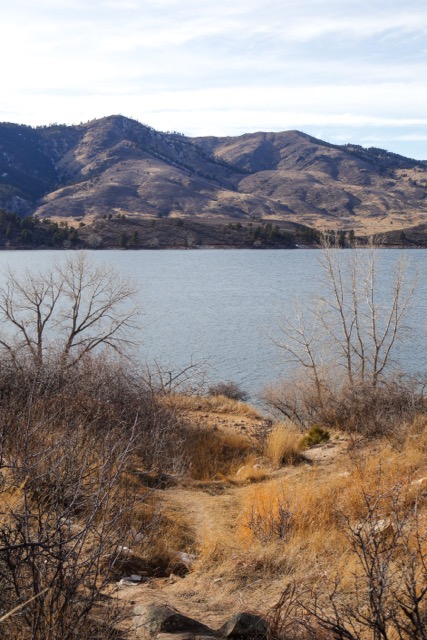
“After a few weeks of struggle, it clicked and became a place for mental rest and semi-good physical recovery. I started to really enjoy waking up at 4:30, driving to the lake, and swimming as the sun came up,” Steele said.
Appreciating and celebrating the small moments throughout this journey will add to the overall reward at the end of it all. And hey, maybe your favorite part of the day will become the 4:30 a.m. swim in a cold lake, too!
Be OK With Being Humbled
Okay, these Ironman athletes can come off as superhuman, but everyone has to get humbled before that finish line.
Trenton’s moment was when he competed in the Boulder Ironman 70.3, which is a fancy way of saying that it’s half the distance of a full Ironman, a few months before his Maryland race. In his own words, it was “a wake-up call.” With about six months of training under his belt, he still wasn’t prepared for what was in store for him.
He woke up already feeling sick, a great sign, right? Then, the race began. He hadn’t biked or run as far as they had to in order to keep pace. Let alone in the hot June heat with no shade in sight. His legs cramped up during the run, and his stomach was in knots the whole race. He could have laid down and accepted defeat. But, alas, he pushed through, finishing the race in about six hours and twelve minutes.
“The entire time I was thinking about having to do double that distance while being unable to run a half-marathon because every single muscle in my legs was cramping, but I’ve already signed up for the full Iron Man in Maryland, so I didn’t have an option of quitting. I had an option of learning. Without that, I would have had a false sense of ability,” Steele said.
It takes a lot for someone to have a wake-up call as intense as this one and still carry on. Maybe you’ll have a similar moment of defeat, or you won’t. Just keep pushing forward because everyone has to get humbled before they make it.
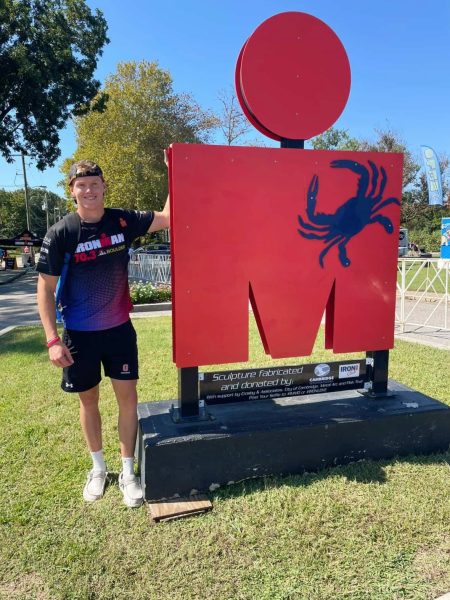
Photo courtesy of Steele Family
Race Day Will Be Chaotic
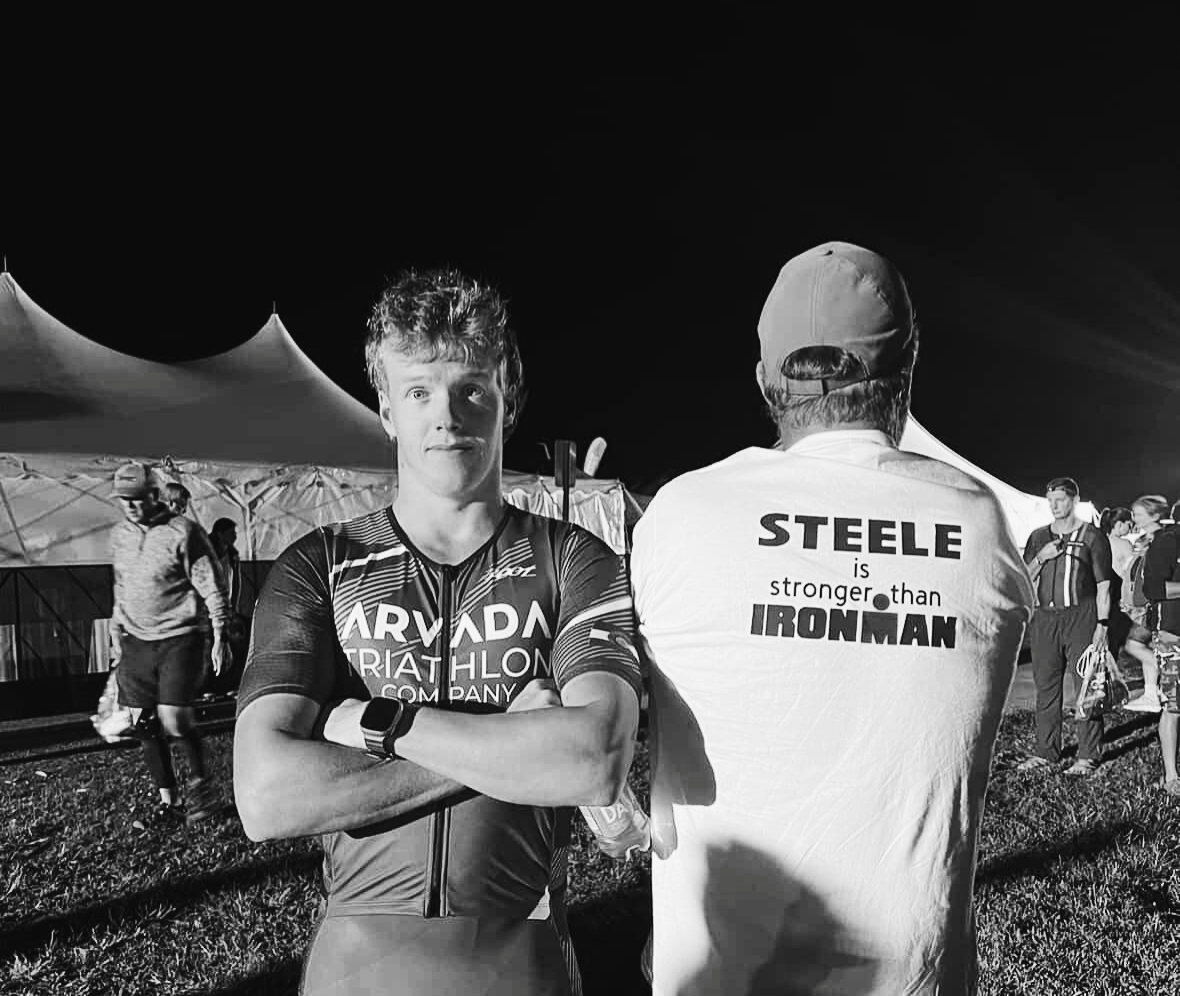
Alright, you’ve almost made it to race day, so now what? All those months of training are about to pay off, or, well, one could hope. The day before, you’ll get checked in and get your bib number, how exciting! But then the reality of the race will start to sink in. And if you’re Trenton, while you’re showing your dad your fancy carbon-plated running shoes, you’ll bend it a little too far, and it’ll snap. That’s when the duct tape you packed will come in handy.
The night before, you’ll have butterflies fluttering around in your stomach out of fear, excitement, and maybe a little hunger. You’ll check all of your gear, yes, including the duct taped shoe, a million times over while mentally reviewing your plan for tomorrow. When it’s finally time to sleep, although difficult, you know that if you don’t force yourself, you’ll really regret it. Finally, you’ll manage to drift off.
You’ll wake up the next morning, have a slight panic attack, triple check that you have all of your gear, and then make your way out the door and over to the start line. The anticipation, nerves, and overall excitement will be clouding over you, but this is what you trained for. Trenton recalls exactly what was going through his head,
“I had all the nerves at the start line, but as soon as I was at the water’s edge, I let it flow over me like a wave of clarity, I had done the training, I knew I could do it, and now was the time to celebrate and show myself why I had done all the prior work,” Steele said.
Of course, nothing will go exactly how you imagined; this will lead to a pretty memorable first obstacle, the 2.4 mile swim.
“During the swim, I got stung by an uncountable number of jellyfish. At one point, one of the turn buoys had blown away, so I didn’t know where I was swimming, and it’s a constant elbow and punch battle with everyone else in the water,” Steele said.
Now, the chances of jellyfish infested water are low, but never zero. Anyways, you’ll push through all of the stings and race over to set up for the 112 mile bike ride.. Remember, you won’t be able to listen to any music on this extremely long and winding ride, so you might get a little bored. Trenton ended up riding off the road not once, but twice out of pure boredom. You’ll start focusing on the shooting pain that has started all throughout your body, but then you’ll look around. The view of the beautiful landscape surrounding you as you pedal on might help ease your mind and make it that much more tolerable. Maybe you’ll even talk to the other bikers riding alongside you.
Once you’ve finished contemplating all of your life choices, you’ll finish the bike ride and transition straight into the 26.2 mile run. This is the final part of the race; you can practically see the finish line and hear your name being called. It’s only 26 miles; how hard can it really be after what you just got through? Well, the answer is pretty difficult. Trenton got through the first 22 miles with the normal amount of struggle, but mile 23 arrived with vengeance.
“I hit mile 23 on the run, and my heart rate tanked from 150 to 110 to 70 in a matter of seconds. This is called bonking, when you don’t have enough fuel in the body, it shuts itself down. My vision tunneled and grew very dark. I went from a run to a walk to a stagger, and I thought I was done. It was over for me,” Steele said.
But there’s no way, with only three miles left, he was going to let his body call quits on him. With some helpful, encouraging words from a passing competitor, he was able to get back up on his feet and kick back into gear.
“She said enough to get my feet moving again until the next aid station, where I stuffed my face with food and got back on the pony for the last 3 miles,” Steele recalled.
YOU ARE AN IRONMAN
Then, after all the moments of struggle, the exact moment you’ve been working tirelessly at for months will be right in front of you. The red carpet, the bell, and the very finish line you’ve been trying to reach will all be there.
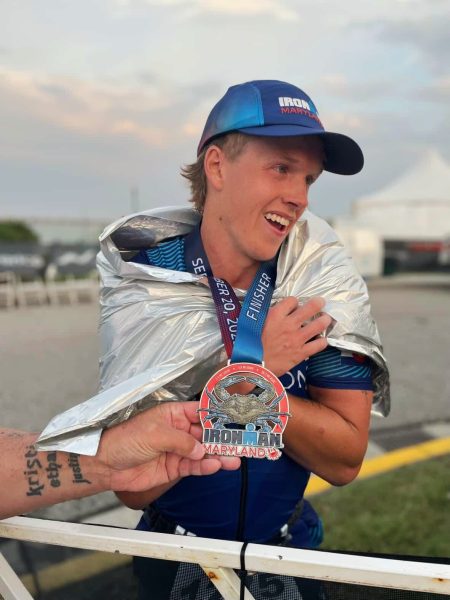
You’ll ring the bell, cross the finish line, and hear the announcer say your name, followed by, “YOU ARE AN IRONMAN.”
Some people describe the feeling as euphoric and extremely emotional. But other people, a.k.a. Trenton, had a different type of finish line experience.
“Physically, it felt amazing to stop running, but it also felt awkward, almost like I should have still been running. Emotionally, it was a little lackluster for me. It was great, don’t get me wrong, but I didn’t get the huge euphoric finish line feeling that people chase after. That was the only finish line that I had set my eyes on for the last nine months, and now I crossed it, so my mind immediately went to what’s next, but at that point, I was starting to shiver and go into full body shock, so other things were a little more important at the time,” Steele said.
Regardless of what you feel, or lack thereof, in the moment, it’s important to remember that you’ve accomplished something truly amazing. Less than 0.01% of the population has completed a full Ironman, crazy! Take a moment to congratulate yourself and understand what you went through to get to that moment.
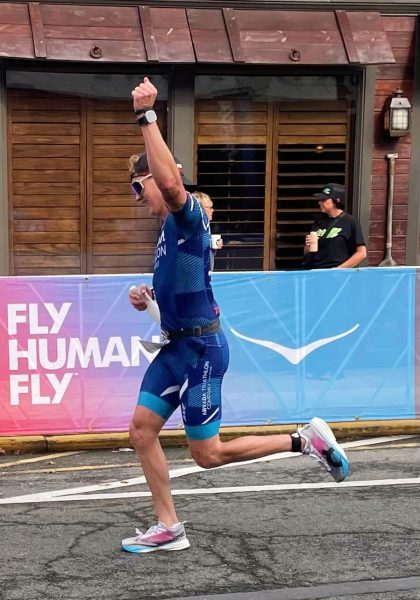
Another One? Maybe Someday
After Trenton crossed that finish line, in 11 hours 41 minutes and 21 seconds, to be exact, the last thing on his mind was, “When’s the next one?” However, after a few months of recovery, he’d probably do another one. His eyes are currently set on Ironman Cozumel 2026, so stay tuned.
His advice to anyone reading this, thinking about competing in the iconic Ironman competition, is to “Just sign up and don’t overcomplicate it. It’s just swimming, biking, and running. The rest will come; you will figure everything out.”